Oklahoma City Thunder vs Golden State Warriors Match Player Stats: Shai Gilgeous-Alexander’s 27 Points Leads OKC to 104-97 Victory
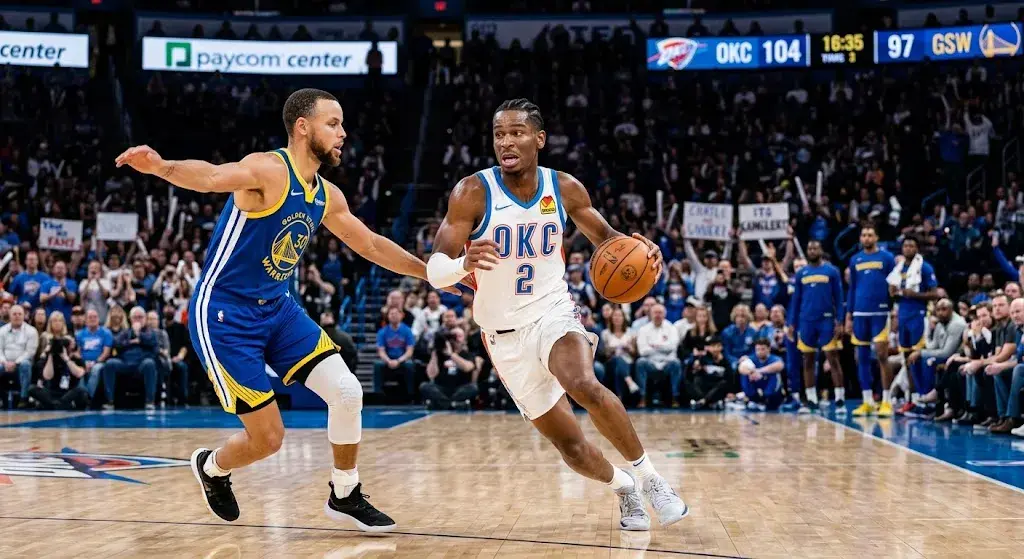
The Oklahoma City Thunder defeated the Golden State Warriors 104-97 on Saturday, March 7, 2026, at Paycom Center in Oklahoma City. This complete breakdown of the oklahoma city thunder vs golden state warriors match player stats reveals how Shai Gilgeous-Alexander scored 27 points, extending his streak of 20-point games to 125 consecutive contests, as the Thunder secured their fifth straight win and became the first NBA team to reach 50 victories this season.
Despite shooting just 6-of-15 from the field, Gilgeous-Alexander converted 14-of-15 free throws to maintain his scoring dominance. Isaiah Joe added 18 points off the bench, while Jaylin Williams contributed nine points and 14 rebounds for an Oklahoma City squad missing three regular starters. The Warriors, playing without Stephen Curry for the 13th consecutive game due to a right knee injury, were led by Gui Santos’ 22 points and 11 rebounds but ultimately fell short in the fourth quarter.
Match Overview Table
| Information | Match Details |
| Event | NBA Regular Season 2025-26 |
| Game | Golden State Warriors vs Oklahoma City Thunder |
| Date | Saturday, March 7, 2026 |
| Venue | Paycom Center, Oklahoma City, OK |
| Attendance | 18,203 |
| Winner | Oklahoma City Thunder |
| Final Score | 104-97 |
| Broadcast | ABC |
Core Match Statistics Overview
| Statistic | Golden State Warriors | Oklahoma City Thunder |
| Field Goals | 36-88 (40.9%) | 33-78 (42.3%) |
| 3-Pointers | 14-45 (31.1%) | 15-42 (35.7%) |
| Free Throws | 11-18 (61.1%) | 23-24 (95.8%) |
| Rebounds | 57 | 49 |
| Assists | 26 | 22 |
| Steals | 8 | 7 |
| Blocks | 3 | 1 |
| Turnovers | 13 | 14 |
| Points in Paint | 42 | 28 |
| Fast Break Points | 4 | 6 |
| Second Chance Points | 16 | 7 |
Free Throw Shooting
The free throw disparity defined this matchup more than any other metric. Oklahoma City’s 95.8% conversion rate from the charity stripe, compared to Golden State’s 61.1%, created a 12-point advantage that proved decisive in a seven-point game.
The Thunder attempted 24 free throws and missed only one, with Gilgeous-Alexander alone making 14-of-15
Golden State left seven points at the line, a critical margin given the final score
Three-Point Shooting
Neither team shot particularly well from beyond the arc, but Oklahoma City’s slightly better efficiency (35.7% vs 31.1%) gave them an edge in a game where both defenses prioritized protecting the paint.
The Warriors attempted 45 three-pointers but connected on only 14, with several late-game misses sealing their fate
Isaiah Joe’s 4-of-8 shooting from deep provided crucial spacing for OKC’s shorthanded rotation
Rebounding Battle
Golden State dominated the glass with a 57-49 advantage, including a 15-7 edge on the offensive boards, yet failed to convert that possession advantage into enough second-chance points.
The Warriors’ 16 second-chance points kept them competitive but couldn’t offset their free-throw struggles
Jaylin Williams’ 14 rebounds anchored OKC’s interior defense in the absence of Chet Holmgren and Isaiah Hartenstein
Period-by-Period Analysis
First Quarter: Thunder 34, Warriors 28
| Team | Q1 Score |
| Golden State Warriors | 28 |
| Oklahoma City Thunder | 34 |
Oklahoma City raced out to an early lead behind Gilgeous-Alexander’s aggressive drives, drawing fouls and converting at the line
Kenrich Williams provided an unexpected scoring punch with 13 first-half points, helping offset the absences of Holmgren and Jalen Williams
Golden State kept pace early through Gui Santos, who scored 14 first-half points to prevent the game from getting away
Second Quarter: Thunder 33, Warriors 26
| Team | Q2 Score |
| Golden State Warriors | 26 |
| Oklahoma City Thunder | 33 |
The Thunder extended their lead to 67-54 at halftime, their largest advantage of the game, by continuing to attack the rim and draw contact
Isaiah Joe found rhythm from three-point range as Oklahoma City’s ball movement created open looks.
Golden State’s offense stagnated without Curry, relying heavily on isolations and contested jumpers
Third Quarter: Warriors 29, Thunder 19
| Team | Q3 Score |
| Golden State Warriors | 29 |
| Oklahoma City Thunder | 19 |
The Warriors mounted a furious comeback, outscoring OKC by ten in the third quarter to cut the deficit to 86-83 heading into the fourth
A three-pointer by Malevy Leons tied the game at 77 with just over four minutes remaining in the period, capping a 23-10 run
Oklahoma City’s offense sputtered as Gilgeous-Alexander struggled with his shot, missing seven of his first nine attempts from the field
Fourth Quarter: Thunder 18, Warriors 14
| Team | Q4 Score |
| Golden State Warriors | 14 |
| Oklahoma City Thunder | 18 |
With the Thunder clinging to a 99-97 lead, Gilgeous-Alexander drilled a contested three-pointer over Draymond Green with 42.4 seconds remaining to seal the victory
Golden State managed just 14 fourth-quarter points, their lowest output of the game, as OKC’s defense tightened in the clutch
The Warriors’ 1-of-8 shooting from three-point range in the final period proved costly
Detailed Team Player Statistics
Oklahoma City Thunder Player Statistics
Shai Gilgeous-Alexander | 27 PTS, 4 REB, 6 AST, 1 STL
Gilgeous-Alexander’s efficiency came from the free-throw line rather than the field, but his ability to draw contact and convert (14-of-15) kept Oklahoma City’s offense afloat. His clutch three-pointer over Draymond Green in the final minute demonstrated why he remains the Thunder’s unquestioned closer.
Isaiah Joe | 18 PTS, 3 REB, 2 AST
Joe provided essential perimeter scoring off the bench, connecting on 4-of-8 three-point attempts to stretch Golden State’s defense. His shooting proved particularly valuable given Oklahoma City’s shorthanded frontcourt.
Jaylin Williams | 9 PTS, 14 REB, 2 AST, 1 BLK
Williams anchored the paint in the absence of Chet Holmgren and Isaiah Hartenstein, pulling down a game-high 14 rebounds. His defensive presence helped limit Golden State to 42 points in the paint despite the Warriors’ offensive rebounding advantage.
Kenrich Williams | 13 PTS, 3 REB
Williams scored a vital 13 points before halftime to give Oklahoma City a 13-point lead. His energy off the bench compensated for the Thunder’s missing starters.
Golden State Warriors Player Statistics
Gui Santos | 22 PTS, 11 REB, 3 AST
Santos produced a team-high 22 points and 11 rebounds, keeping the Warriors competitive throughout. His 14 first-half points prevented Oklahoma City from running away early, but he managed just eight points after halftime as the Thunder adjusted.
Brandin Podziemski | 17 PTS, 5 REB, 4 AST
Podziemski shouldered significant playmaking duties in Curry’s absence, contributing 17 points and four assists. However, his 6-of-16 shooting performance reflected the difficulty of creating offense against OKC’s elite perimeter defense.
Draymond Green | 16 PTS, 4 REB, 4 AST
Green scored 16 points on efficient shooting but struggled with turnovers, committing several costly giveaways in the fourth quarter. His defensive matchup with Gilgeous-Alexander on the game-sealing three-pointer ended in the Thunder star’s favor.
Statistical Leaders Summary Table
| Category | Oklahoma City Thunder | Golden State Warriors |
| Leading Scorer | Shai Gilgeous-Alexander (27) | Gui Santos (22) |
| Second Leading Scorer | Isaiah Joe (18) | Brandin Podziemski (17) |
| Top Rebounder | Jaylin Williams (14) | Gui Santos (11) |
| Most Assists | Shai Gilgeous-Alexander (6) | Draymond Green (4) |
Analytical Breakdowns
Why Oklahoma City Won
### Free Throw Dominance
The Thunder’s 23-of-24 performance from the free-throw line stands as the single most decisive statistical factor in this game. Oklahoma City generated 12 more points at the stripe than Golden State, which proved to be the exact margin needed to secure victory.
| Free Throw Comparison | OKC | GSW |
| Made-Attempted | 23-24 | 11-18 |
| Percentage | 95.8% | 61.1% |
| Points Generated | 23 | 11 |
### Clutch Execution
When the game tightened in the final minutes, Oklahoma City executed while Golden State faltered. With 42.4 seconds left, Gilgeous-Alexander’s three-pointer over Green increased the Warriors’ two-point lead to five, thus eliminating their chances.
### Bench Production
With three starters unavailable, Oklahoma City’s reserves delivered. Isaiah Joe (18 points) and Kenrich Williams (13 points) combined for 31 points off the bench, outpacing Golden State’s reserve contributions.
Why Golden State Lost
### Inability to Convert at the Line
Golden State’s 61.1% free-throw shooting represents a significant execution failure. In a game decided by seven points, the Warriors left seven points unclaimed at the charity stripe.
### Heavy Dependence on Santos
Gui Santos accounted for 22 of Golden State’s 97 points, but the Warriors lacked secondary scoring options capable of consistently creating offense. Without Curry, the team’s offensive hierarchy became predictable.
### Fourth-Quarter Offensive Collapse
The Warriors managed just 14 points in the final period, shooting 1-of-8 from three-point range. Their inability to generate quality looks against OKC’s switching defense exposed the limitations of their shorthanded roster.
Historical Context & Advanced Insights
Season Series Breakdown
| Date | Result | Location |
| November 11, 2025 | OKC 126, GSW 102 | Paycom Center |
| December 2, 2025 | OKC 124, GSW 112 | Chase Center |
| January 2, 2026 | OKC 131, GSW 94 | Chase Center |
| March 7, 2026 | OKC 104, GSW 97 | Paycom Center |
Oklahoma City swept the season series 4-0, winning by an average margin of 18.5 points per game across the four meetings. The Thunder’s dominance included three double-digit victories, with only the March 7 matchup remaining competitive into the fourth quarter.
Advanced Statistical Insights
Oklahoma City’s assist-to-field-goal ratio in this game (22 assists on 33 made field goals, 66.7%) reflects a balanced offensive approach despite the absence of primary playmakers. Golden State, by contrast, recorded 26 assists on 36 made baskets (72.2%), suggesting better ball movement but inferior finishing at the rim and the free-throw line.
The Thunder’s efficiency per possession tells a compelling story: despite attempting ten fewer field goals than Golden State (78 vs 88), Oklahoma City scored seven more points. This discrepancy stems almost entirely from free-throw generation and conversion, highlighting how the Thunder’s aggressive rim-attacking style created higher-value possessions.
Game Implications & Key Lessons
What This Means for Oklahoma City
The Thunder improved to 50-15 and became the first team in the league to reach 50 wins, strengthening their position atop the Western Conference standings
Oklahoma City demonstrated resilience in winning without three starters (Holmgren, Jalen Williams, Hartenstein), building confidence in their depth for the postseason
Gilgeous-Alexander’s 125-game streak of 20-point performances continues to cement his status as the league’s most consistent scorer
What This Means for Golden State
The Warriors fell to 32-31, remaining on the playoff bubble in the crowded Western Conference
Golden State’s inability to win without Curry raises concerns about their offensive sustainability if their star guard’s knee issue persists
The free-throw shooting struggles (61.1%) represent a correctable flaw that has cost the Warriors in close games this season
Key Lessons
Free throw shooting remains the most controllable variable in close basketball games; Oklahoma City’s 95.8% versus Golden State’s 61.1% decided this contest
As Gilgeous-Alexander showed with 27 points on 6-of-15 shooting, elite scorers can still deliver even on bad shooting nights.
Bench depth separates contenders from pretenders; Oklahoma City’s reserves outscored Golden State’s 31-25 in a game where starters were missing
Defensive adjustments matter: OKC limited Golden State to 14 fourth-quarter points after allowing 29 in the third
A 13-point halftime lead can evaporate quickly in the NBA, but clutch execution in the final two minutes preserves victories
Rebounding advantages (Golden State’s 57-49 edge) mean little without corresponding efficiency at the free-throw line and from three-point range
Conclusion
Oklahoma City’s 104-97 victory over Golden State showcased the Thunder’s championship-caliber depth and composure. Even without three starters, Oklahoma City found enough offense through Gilgeous-Alexander’s free-throw mastery, Isaiah Joe’s perimeter shooting, and Jaylin Williams’ rebounding tenacity. The Warriors, meanwhile, demonstrated the limitations of their shorthanded roster: effort and rebounding advantages mean little when free throws are missed and fourth-quarter execution falters. In a game defined by efficiency rather than volume, the Thunder’s 95.8% free-throw shooting stood as the clearest separator between these two teams.
For a complete statistical review of the oklahoma city thunder vs golden state warriors match player stats, this game illustrated how free-throw efficiency, bench production, and clutch execution outweigh raw rebounding numbers. The oklahoma city thunder vs golden state warriors match player stats from this March 7 showdown will be remembered as another chapter in Gilgeous-Alexander’s historic scoring run and a stark reminder of Golden State’s dependence on Curry’s availability.